Baccarat Tie Bet: Odds, 8:1 Payout and House Edge
How often a baccarat Tie happens, what 8:1 and 9:1 Tie payouts really cost, what happens to Banker and Player bets, and how Ties appear on the roads.
Key takeaways
- A Tie happens when Banker and Player finish with the same total. In 8-deck baccarat it happens in about 9.52% of hands — roughly 1 in every 10.5 hands.
- Most tables pay a Tie at 8:1, which gives a house edge of about 14.36%. A few pay 9:1, which lowers it to about 4.84%.
- When the result is a Tie, Banker and Player bets push — the stake is returned, neither won nor lost.
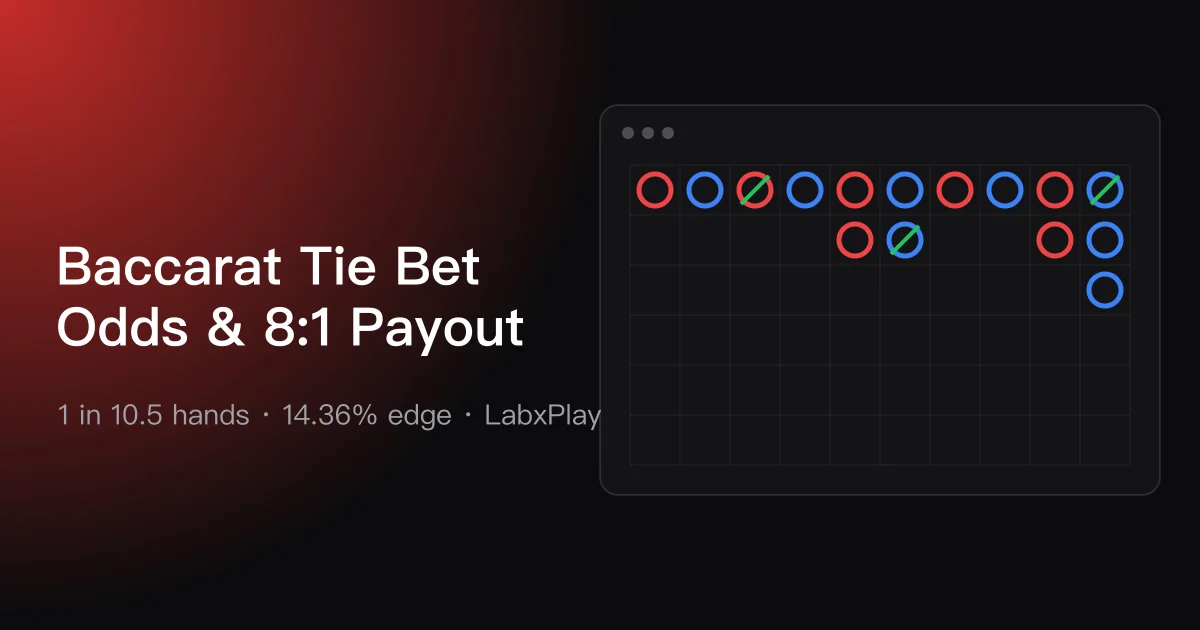
- On the Big Road a Tie is a green slash on the previous circle, on the Bead Road it is a green dot, and the derived roads ignore it.
- Ties are never "due". Every hand is independent.
What is a Tie in baccarat?
A Tie is the result when the Banker hand and the Player hand end with the same point total. For example, Player 7 and Banker 7 is a Tie. The cards are dealt using the normal drawing rules; nothing special happens when a Tie comes up — the hand simply ends with equal totals.
The Tie bet is one of the three main bets, alongside Banker and Player. You win it only if the hand ends in a Tie.
How often does a Tie happen?
In standard 8-deck baccarat, a Tie happens in about 9.52% of hands, or roughly once every 10.5 hands.
| Result | Probability (8 decks) |
|---|---|
| Banker wins | about 45.86% |
| Player wins | about 44.62% |
| Tie | about 9.52% |
A typical shoe has 70 or more hands, so you will usually see around six to eight Ties. Some shoes have many more, and some have very few — that is normal random variation, not a signal.
What does a Tie pay: 8:1 or 9:1?
Most tables pay 8:1 on a Tie, and that is what LabxPlay tables use. A few tables pay 9:1. The difference looks small, but it changes the house edge a lot.
| Tie payout | You win on a 100 bet | House edge |
|---|---|---|
| 8:1 | +800 | about 14.36% |
| 9:1 | +900 | about 4.84% |
"8:1" means you win 8 times your stake and keep the stake. Some tables write the same payout as "9 for 1", which includes the returned stake — check how a table states it before comparing.
What happens to Banker and Player bets on a Tie?
In standard baccarat, Banker and Player bets push on a Tie: the stake is returned. You do not lose, but you do not win either. This is why the house edge for Banker (about 1.06%) and Player (about 1.24%) stays low — about one hand in ten simply returns your bet.
A worked example: 100 hands of Tie bets
Imagine betting 100 points on Tie in each of 100 hands, at 8:1. That is 10,000 points staked in total.
- On average about 9.5 hands are Ties: 9.5 × 800 = +7,612 (rounded).
- About 90.5 hands are not Ties: 90.5 × 100 = −9,048 (rounded).
- Expected result: about −1,436 points, or 14.36% of everything you staked.
At a 9:1 table the same 100 hands would cost about 484 points. For comparison, the same 10,000 points on Banker would cost about 106 points on average.
Of course, real results swing far from the average. You might hit 15 Ties and finish ahead, or hit 4 and lose much more. The average is what the math settles towards over many hands, and it is always negative.
How is a Tie drawn on the roads?
A Tie is recorded on the roads, but it does not take a column or a new cell on the Big Road.
- Big Road: a green slash is drawn across the circle of the last Banker or Player result. On LabxPlay, a number on the circle shows how many Ties happened there in a row.
- Bead Road: every hand gets its own cell, so a Tie appears as a green dot in order.
- Derived roads (Big Eye Boy, Small Road, Cockroach Road): Ties are ignored, because they are calculated from the Big Road columns only.
Each LabxPlay table also shows the B / P / T count for the current shoe, so you can see at a glance how many Ties there have been. Learn how each road works in our complete roadmap guide, and look up any term in the glossary.
Is a Tie "due" after a long time without one?
No. A Tie has the same chance on every hand, no matter how long it has been since the last one. A shoe with 20 hands and no Tie does not make the next hand more likely to be a Tie, and a shoe with many Ties does not "use them up".
Patterns on the roads only record the past. Read more in Is There a Baccarat Winning Strategy? and our guide to roadmap patterns.
Why is the Tie the costliest main bet?
The Tie pays the most, but at 8:1 it does not pay enough. To break even, a 9.52% result would need to pay about 9.5:1. At 8:1 the house keeps about 14.36% of every point staked on Tie over time — more than ten times the edge on Banker or Player.
| Bet | Payout | House edge |
|---|---|---|
| Banker | 0.95:1 | about 1.06% |
| Player | 1:1 | about 1.24% |
| Tie | 8:1 | about 14.36% |
Watch Ties on LabxPlay
LabxPlay is free and uses virtual points only — points cannot be bought, deposited or cashed out, and they reset to 600,000 every day at midnight. You can follow live Evolution tables and our own Labx Speed tables, see how each Tie is drawn on the roads, and try the Tie bet with virtual points to see how the numbers play out. LabxPlay is for players aged 18+.
Remember: every hand is independent, and no road or bet can predict the next result.
Practise on live Evolution tables
Open LabxPlay to follow every road in real time and test your reading with virtual points.
Related articles
- Baccarat Pair Bets: Player Pair, Banker Pair and 11:1 OddsWhat Player Pair and Banker Pair mean in baccarat, how often a pair appears, why 11:1 still has a 10.36% house edge, and how pairs show on the roadmap.
- No Commission Baccarat Explained: Rules, Payouts and the Banker 6How No Commission Baccarat works, how its payouts differ from standard baccarat, and why a Banker win with 6 paying half changes the house edge.
- Baccarat Small Road: How to Read the Second Derived RoadHow to read the Small Road in baccarat: where it starts, the two rules behind every red and blue dot, and a full step-by-step worked example.
- Play Baccarat Free: How to Practise Without MoneyPlay baccarat free with virtual points: learn the rules, read the Big Road and derived roads, and practise bankroll discipline on LabxPlay — no money needed.