Baccarat Pair Bets: Player Pair, Banker Pair and 11:1 Odds
What Player Pair and Banker Pair mean in baccarat, how often a pair appears, why 11:1 still has a 10.36% house edge, and how pairs show on the roadmap.
Key takeaways
- A Player Pair wins when the Player's first two cards are the same rank; a Banker Pair wins when the Banker's first two cards are the same rank. Suit does not matter.
- Both bets usually pay 11:1, and they win no matter which hand wins the round.
- In an 8-deck shoe, a given side is dealt a pair about 7.47% of the time, roughly once every 13 to 14 hands.
- At 11:1, the house edge on a pair bet is about 10.36%, around ten times higher than the Banker or Player bet.
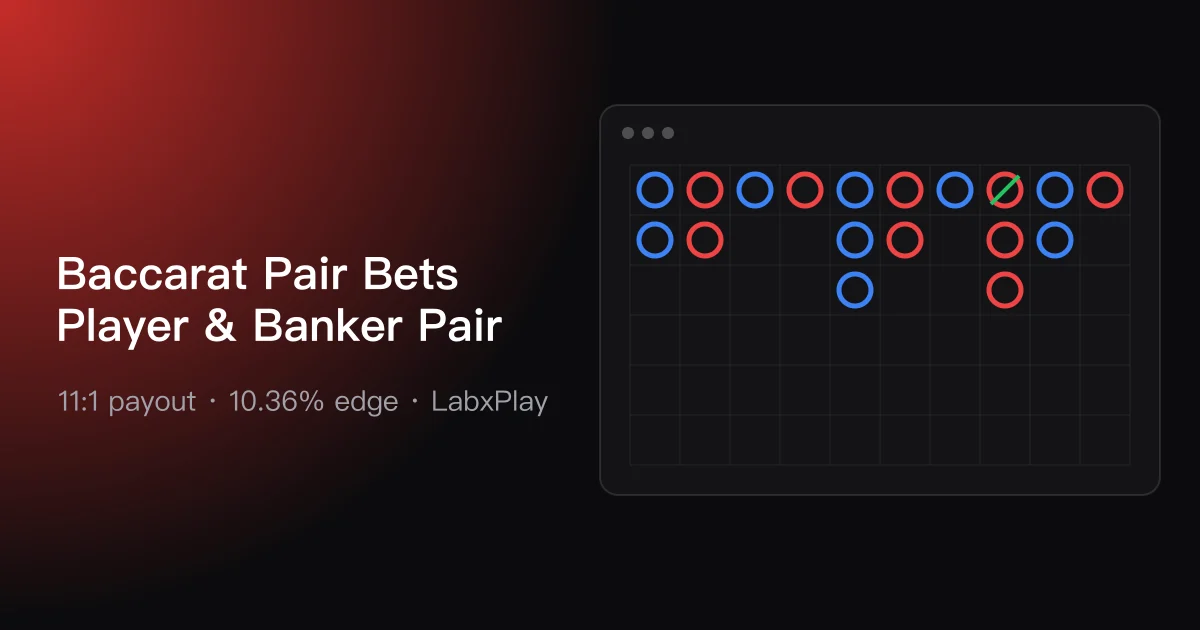
- On the roadmap, pairs appear as small dots on the circles. On LabxPlay, a blue dot marks a Player pair and a red dot marks a Banker pair.
What is a Player Pair or Banker Pair bet?
A pair bet is a side bet on whether the first two cards of one hand will be the same rank. You place it next to your main bet, or on its own.
- Player Pair: the Player's first two cards match, for example two 7s or two Kings.
- Banker Pair: the Banker's first two cards match.
Only the rank counts. A 7 of hearts and a 7 of clubs is a pair. A King and a Queen is not, even though both count as 0 points. A third card, if one is drawn, does not matter for the pair bet.
The pair bet is also independent of who wins. A Player Pair still pays if the Banker wins the hand, or if the round ends in a tie. Need a refresher on how the hands are dealt? See our baccarat rules guide.
How much does a pair bet pay?
A pair bet usually pays 11:1. If you bet 100 and the pair appears, you win 1,100 and keep your 100 stake. If no pair appears, you lose the 100.
| Bet | Payout on LabxPlay |
|---|---|
| Player | 1:1 |
| Banker | 0.95:1 |
| Tie | 8:1 |
| Player Pair | 11:1 |
| Banker Pair | 11:1 |
How often does a pair appear?
In an 8-deck shoe, the chance that one particular side gets a pair is about 7.47%. The first card can be anything. Of the 415 cards left, 31 share its rank, and 31 ÷ 415 ≈ 7.47%.
That works out to about once every 13.4 hands for each side. In a shoe of 70 hands, you would expect around 5 Player pairs and around 5 Banker pairs on average, but real shoes vary a lot. Some show none for a long stretch, others show several close together.
What is the house edge on a pair bet?
The house edge on an 11:1 pair bet is about 10.36%. A payout of 11:1 sounds generous, but a fair payout for a 7.47% chance would be about 12.4:1. The gap between the two is where the edge comes from.
Worked example
Imagine placing a pair bet of 100 points on 1,000 hands, a total of 100,000 points.
- Expected pairs: 1,000 × 7.47% ≈ 75 hands.
- Each win returns 1,200 (1,100 winnings plus the 100 stake): 75 × 1,200 ≈ 89,600.
- Expected loss: 100,000 − 89,600 ≈ 10,400 points, or about 10.4% of everything wagered.
The same 100,000 points on Banker would lose about 1,060 on average.
Pair bets vs. main bets: the comparison
| Bet | Payout | House edge (8 decks) |
|---|---|---|
| Banker | 0.95:1 | about 1.06% |
| Player | 1:1 | about 1.24% |
| Tie | 8:1 | about 14.36% |
| Player Pair / Banker Pair | 11:1 | about 10.36% |
Why do side bets cost more than the main bets?
Side bets cost more because their payouts are set further below the fair price. Big payouts make them feel attractive, but the casino keeps a larger slice of every bet. The pair bet sits between the main bets and the Tie: cheaper than Tie, but roughly ten times more expensive than Banker or Player.
No roadmap pattern changes this. Every hand is dealt independently, so a long gap without pairs does not make a pair "due." Read more in the truth about baccarat strategy.
How are pairs marked on the roadmap?
Pairs are shown as small dots at the corner of a circle on the Big Road and Bead Road. On LabxPlay:
- A small blue dot marks a hand where the Player had a pair.
- A small red dot marks a hand where the Banker had a pair.
A single circle can carry both dots if both sides were dealt a pair. The dots do not change how the road is drawn; they only add information. The table summary on LabxPlay also counts P, B, T, P-pair and B-pair for the current shoe.
Learn how every road is drawn in our complete roadmap guide, and look up terms in the baccarat glossary. Pair bets work the same way on No Commission tables.
Practise pair bets on LabxPlay with virtual points
LabxPlay tracks live Evolution baccarat tables in real time, and also runs its own Labx Speed tables (A to F) with the same rules. You can place Player Pair and Banker Pair bets at 11:1 using virtual points only. Points cannot be bought, deposited or cashed out, and they reset to 600,000 every day at midnight. LabxPlay is for players aged 18+.
Watching how rarely pairs land, and how quickly an 11:1 bet drains a balance over time, is one of the clearest ways to understand the house edge.
Practise on live Evolution tables
Open LabxPlay to follow every road in real time and test your reading with virtual points.
Related articles
- Baccarat Tie Bet: Odds, 8:1 Payout and House EdgeHow often a baccarat Tie happens, what 8:1 and 9:1 Tie payouts really cost, what happens to Banker and Player bets, and how Ties appear on the roads.
- No Commission Baccarat Explained: Rules, Payouts and the Banker 6How No Commission Baccarat works, how its payouts differ from standard baccarat, and why a Banker win with 6 paying half changes the house edge.
- Banker or Player in Baccarat? Odds and House Edge ComparedBanker or Player — which baccarat bet is better? Compare win probabilities, payouts, the 5% commission and the house edge of Banker, Player and Tie.
- Baccarat Rules Explained: Card Values, Payouts and the Third-Card RuleLearn how baccarat works: how cards are counted, who wins, how each bet pays, and exactly when Player and Banker draw a third card.