Baccarat Rules Explained: Card Values, Payouts and the Third-Card Rule
Learn how baccarat works: how cards are counted, who wins, how each bet pays, and exactly when Player and Banker draw a third card.
Key takeaways
- Baccarat has two hands, Player and Banker. The hand closest to 9 wins.
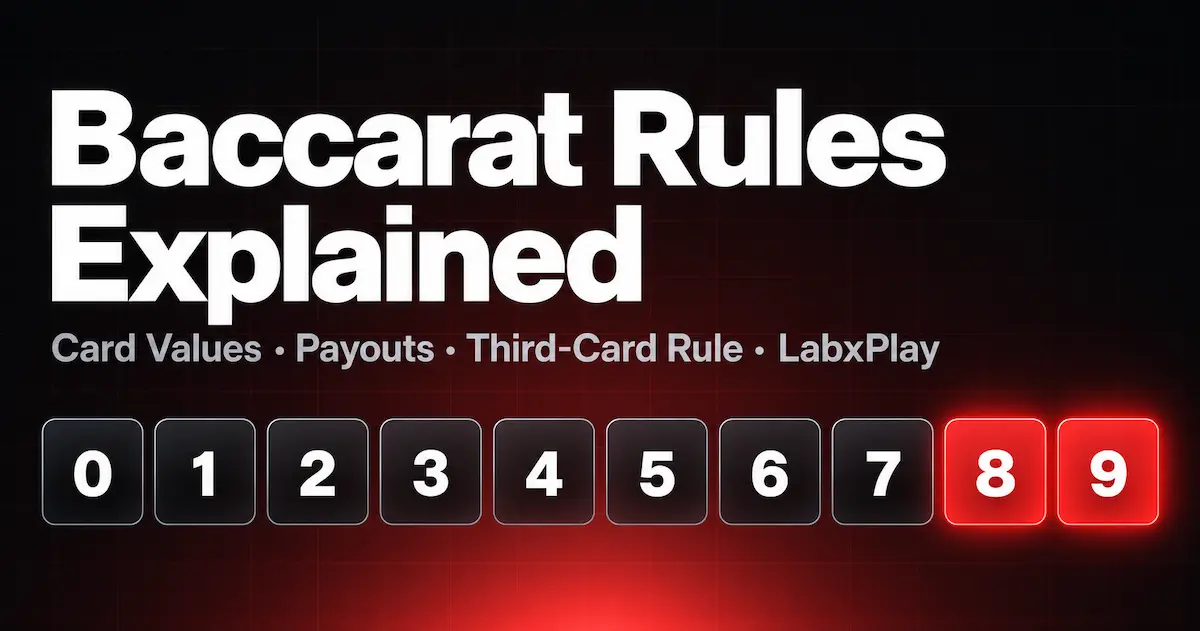
- 10s and face cards count as 0, aces count as 1, and only the last digit of a total counts.
- Whether a third card is drawn is decided by fixed rules. Nobody makes a choice during the hand.
- Player and Banker pay 1:1 (Banker usually minus a 5% commission). Tie usually pays 8:1.
How a hand works
Before the cards are dealt, you bet on Player, Banker or Tie. The dealer then gives two cards to each hand. Depending on the totals, one or both hands may receive a third card.
The hand closer to 9 wins. If both hands have the same total, the result is a Tie.
"Player" and "Banker" are just the names of the two hands. You don't play against the dealer, and you can bet on either side.
Card values
| Card | Value |
|---|---|
| Ace | 1 |
| 2 to 9 | Face value |
| 10, J, Q, K | 0 |
If a total is 10 or more, drop the first digit. For example, 7 + 8 = 15, so the hand is worth 5. The highest possible total is 9.
Naturals: 8 or 9
If either hand has a total of 8 or 9 with its first two cards, it's called a natural. Both hands stand, no more cards are dealt, and the hand is decided straight away.
Player's third card
| Player's first two cards | What happens |
|---|---|
| 0 to 5 | Player draws a third card |
| 6 or 7 | Player stands |
| 8 or 9 | Natural, Player stands |
Banker's third card
If Player stood with two cards, Banker follows the same rule: it draws on 0 to 5 and stands on 6 or 7.
If Player drew a third card, Banker looks at its own total and at Player's third card:
| Banker's total | Banker draws when Player's third card is |
|---|---|
| 0, 1 or 2 | Any card (always draws) |
| 3 | Any card except 8 |
| 4 | 2 to 7 |
| 5 | 4 to 7 |
| 6 | 6 or 7 |
| 7 | Never (Banker stands) |
Three examples
- Player 3 + 4 = 7, Banker K + 5 = 5. Player stands on 7. Player didn't draw, so Banker draws on 5.
- Player A + 3 = 4, Banker 2 + 4 = 6. Player draws a 6: 4 + 6 = 10, so Player now has 0. Banker has 6 and Player's third card is a 6, so Banker draws.
- Player 5 + 3 = 8, Banker 4 + 2 = 6. Player has a natural 8. The hand ends and Player wins.
Payouts
| Bet | Pays | Notes |
|---|---|---|
| Player | 1:1 | |
| Banker | 1:1 minus 5% commission | No Commission tables use a different rule |
| Tie | Usually 8:1 | Player and Banker bets are returned on a Tie |
Read how No Commission tables change the Banker payout in our No Commission Baccarat guide. Side bets such as pairs have their own payouts and a higher house edge.
What the rules mean for you
Because every draw is automatic, there are no decisions to make inside a hand. The only choice is which bet to place, and no pattern on the roadmap changes the odds of the next hand. Read more in Is There a Baccarat Winning Strategy?
Every result is recorded on the roadmap. Learn how to read it in our complete roadmap guide.
Practise on LabxPlay
On LabxPlay you can watch live Evolution tables, see how each hand is recorded on the roadmap, and practise with virtual points. Read more in our FAQ.
Practise on live Evolution tables
Open LabxPlay to follow every road in real time and test your reading with virtual points.