Baccarat Small Road: How to Read the Second Derived Road
How to read the Small Road in baccarat: where it starts, the two rules behind every red and blue dot, and a full step-by-step worked example.
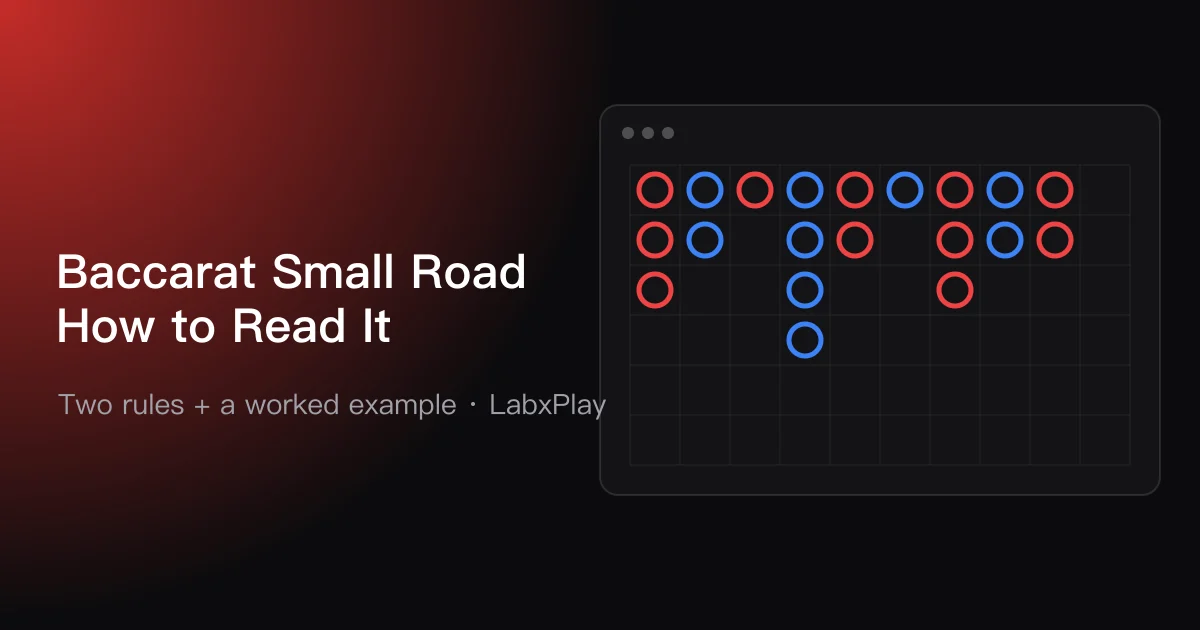
Key takeaways
- The Small Road is calculated from the Big Road. Red and blue describe the shape of the Big Road — not Banker or Player.
- It compares each new Big Road result with the column two places to the left.
- It starts at the 2nd row of the 3rd Big Road column (or the 1st row of the 4th column).
- Ties are ignored, because they do not take a cell on the Big Road.
What is the Small Road?
The Small Road is the second of the three derived roads, after the Big Eye Boy and before the Cockroach Pig. It is drawn with small solid (filled) dots, red or blue. Some players and apps also call it the Small Eye.
Like the Big Eye Boy, it does not tell you who won. For every new result on the Big Road it answers one question: is the Big Road repeating its pattern (red) or breaking it (blue)? The only difference is that the Small Road skips one column and looks two columns back, so it checks a slightly longer stretch of history.
If you have not read part 1 yet, start with the Big Eye Boy guide — the rules are the same, so this article will feel familiar.
Where does the Small Road start?
The first dot appears at:
- the 2nd row of the 3rd column of the Big Road, or
- the 1st row of the 4th column, if the 3rd column has only one result.
Before that point there is not enough history to compare two columns back, so nothing is drawn. After it, every new Big Road result adds exactly one dot.
The two rules
Rule 1 — the result starts a new column. Take the column just before the new one, and compare its length with the column two places further left of it. In other words, for new column N, compare column N−1 with column N−3.
- Same length → 🔴 red
- Different length → 🔵 blue
Rule 2 — the result continues down a column (row n). Look at the column two places to the left (N−2):
- It has a result on row n → 🔴 red
- Row n is empty, but row n−1 is filled (that column ended exactly one row higher) → 🔵 blue
- Rows n and n−1 are both empty → 🔴 red
Dots are laid out like the Big Road: the same colour goes down, and a change of colour starts a new column.
Worked example
We use the same sample Big Road as in part 1 (B = Banker, P = Player), so you can compare the two roads directly. In short: B B B | P P | B | P P P P | B B | P | B B B | P P | B B.
| Row | C1 | C2 | C3 | C4 | C5 | C6 | C7 | C8 | C9 |
|---|---|---|---|---|---|---|---|---|---|
| 1 | B | P | B | P | B | P | B | P | B |
| 2 | B | P | P | B | B | P | B | ||
| 3 | B | P | B | ||||||
| 4 | P |
Column lengths: C1 = 3, C2 = 2, C3 = 1, C4 = 4, C5 = 2, C6 = 1, C7 = 3, C8 = 2, C9 = 2.
C3 has only one result, so there is no "2nd row of the 3rd column". The Small Road therefore starts at C4, row 1. Now we calculate it result by result:
| Step | Big Road result | Rule | Check | Mark |
|---|---|---|---|---|
| 1 | C4, row 1 | New column | C3 (1) vs C1 (3): different | 🔵 |
| 2 | C4, row 2 | Same column | C2 has a result on row 2 | 🔴 |
| 3 | C4, row 3 | Same column | C2 row 3 empty, row 2 filled | 🔵 |
| 4 | C4, row 4 | Same column | C2 rows 3 and 4 both empty | 🔴 |
| 5 | C5, row 1 | New column | C4 (4) vs C2 (2): different | 🔵 |
| 6 | C5, row 2 | Same column | C3 row 2 empty, row 1 filled | 🔵 |
| 7 | C6, row 1 | New column | C5 (2) vs C3 (1): different | 🔵 |
| 8 | C7, row 1 | New column | C6 (1) vs C4 (4): different | 🔵 |
| 9 | C7, row 2 | Same column | C5 has a result on row 2 | 🔴 |
| 10 | C7, row 3 | Same column | C5 row 3 empty, row 2 filled | 🔵 |
| 11 | C8, row 1 | New column | C7 (3) vs C5 (2): different | 🔵 |
| 12 | C8, row 2 | Same column | C6 row 2 empty, row 1 filled | 🔵 |
| 13 | C9, row 1 | New column | C8 (2) vs C6 (1): different | 🔵 |
| 14 | C9, row 2 | Same column | C7 has a result on row 2 | 🔴 |
The Big Road has 20 results, and 6 of them (C1–C3) come before the starting point — so the Small Road has exactly 14 dots. In order:
🔵 🔴 🔵 🔴 🔵 🔵 🔵 🔵 🔴 🔵 🔵 🔵 🔵 🔴
Laid out like the Big Road, that becomes eight columns:
| Row | 1 | 2 | 3 | 4 | 5 | 6 | 7 | 8 |
|---|---|---|---|---|---|---|---|---|
| 1 | 🔵 | 🔴 | 🔵 | 🔴 | 🔵 | 🔴 | 🔵 | 🔴 |
| 2 | 🔵 | 🔵 | ||||||
| 3 | 🔵 | 🔵 | ||||||
| 4 | 🔵 | 🔵 |
You can see the same result drawn with filled dots in the roadmap guide.
Notice how different this is from the Big Eye Boy of the same shoe (🔴 🔵 🔵 🔵 🔴 🔴 …). Looking two columns back, this Big Road almost never repeated a column length, so the Small Road comes out mostly blue.
How to read a finished Small Road
- Long red columns: the Big Road has been regular when compared two columns back — for example, column lengths repeating every other column.
- Long blue columns: the Big Road has kept changing shape compared with two columns earlier.
- Red and blue alternating: no clear structure in either direction.
- Compare with the other derived roads: the Big Eye Boy looks one column back, the Small Road two and the Cockroach Pig three, so the same Big Road can look regular on one and choppy on another.
Remember that this describes what has already happened. It does not make any next result more likely — every hand is independent, and no road can predict the next one.
Common mistakes
- Reading red as Banker. In the Small Road, red and blue never mean Banker or Player.
- Starting too early. Nothing is drawn before the 2nd row of the 3rd column (or the 1st row of the 4th column).
- Using the wrong column for Rule 1. For a new column, compare the column just before it with the one two places further left — not with the new column itself.
- Using the wrong column for Rule 2. When a column grows, look two places to the left, not one. One place is the Big Eye Boy.
- Counting ties. Ties are only a mark on the Big Road and are skipped.
Practise on LabxPlay
On LabxPlay, open any live Evolution table and switch to the Small Eye tab to watch the Small Road update round by round. Use the P next and B next buttons to preview how the roads would change before the result comes in — then work out the next dot yourself and check it.
You can also practise on Labx Speed (tables A–F), LabxPlay's own tables, whose results come from LabxPlay's own system rather than Evolution. LabxPlay is free and uses virtual points only: they cannot be bought or cashed out, and they reset to 600,000 every day. LabxPlay is not affiliated with Evolution and is for players aged 18+.
Next in the series: the Cockroach Pig, which looks three columns back. For quick definitions, see the glossary.
Practise on live Evolution tables
Open LabxPlay to follow every road in real time and test your reading with virtual points.
Related articles
- Cockroach Pig Baccarat: How to Read the Stick RoadHow to read the baccarat Cockroach Pig (Cockroach Road, Stick): where it starts, the two rules behind every red and blue slash, and a full worked example.
- Big Eye Boy Explained: How to Read Baccarat's First Derived RoadA step-by-step guide to the Big Eye Boy in baccarat: where it starts, the two rules behind every red and blue mark, and a full worked example.
- Play Baccarat Free: How to Practise Without MoneyPlay baccarat free with virtual points: learn the rules, read the Big Road and derived roads, and practise bankroll discipline on LabxPlay — no money needed.
- Bead Road Baccarat: How to Read the Bead PlateHow to read the baccarat Bead Road (Bead Plate): one circle per round, six rows per column, B/P/T colours, pair dots, and how it differs from the Big Road.