Bead Road Baccarat: How to Read the Bead Plate
How to read the baccarat Bead Road (Bead Plate): one circle per round, six rows per column, B/P/T colours, pair dots, and how it differs from the Big Road.
Key takeaways
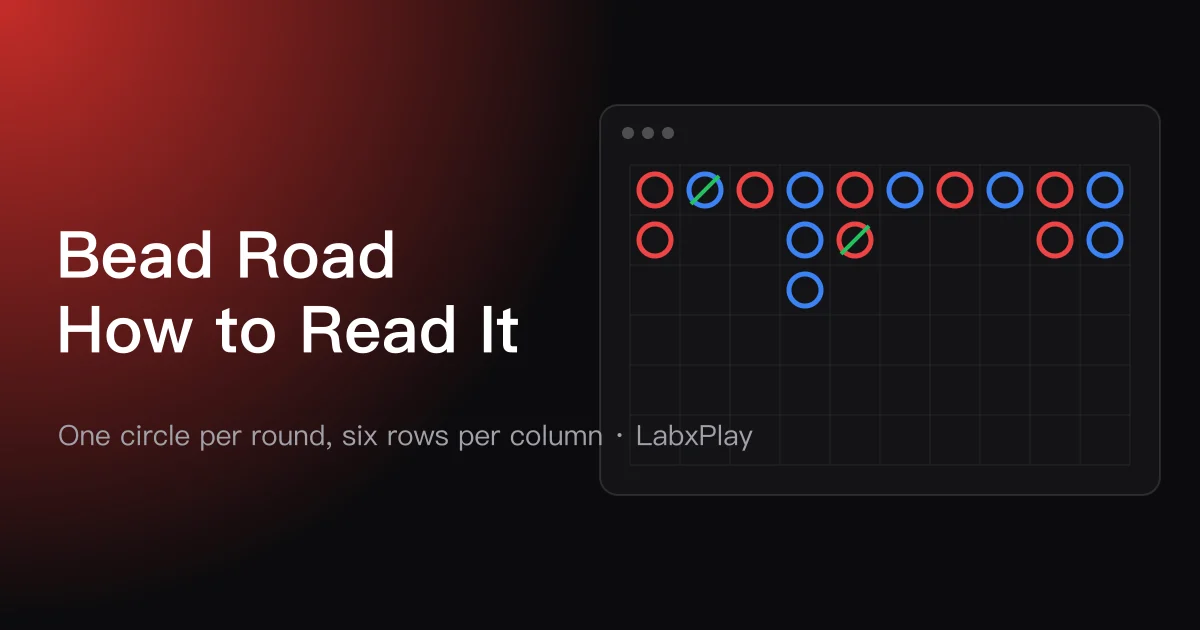
- The Bead Road (also called the Bead Plate) records every round in order, including Ties — one filled circle per round.
- It fills top to bottom, six rows per column, then moves to the next column on the right.
- Red = Banker, blue = Player, green = Tie. Small corner dots mark pairs.
- It is the easiest road for counting results. Like every road, it records the past and cannot predict the next hand.
What is the Bead Road?
The Bead Road is the simplest baccarat road: a grid where each round gets exactly one filled circle, in the order the rounds were played. Nothing is grouped, skipped or calculated.
Together with the Big Road, it is one of the two roads that record results directly. The three derived roads — Big Eye Boy, Small Road and Cockroach Pig — are calculated from the Big Road, not from the Bead Road. You can find a short definition in our glossary and a diagram in the roadmap guide.
How do you read the Bead Road?
Read it like a page of text turned on its side: down each column first, then left to right.
- One circle per round. Every result — Banker, Player or Tie — takes the next empty cell.
- Six rows per column. When a column has six circles, the next result starts at the top of the next column.
- Colours and letters. Red B = Banker win, blue P = Player win, green T = Tie.
- Totals instead of letters. On some tables the circle shows the winning hand's total (for example 7 or 9) instead of a letter. The colour still tells you who won.
- Pair dots. A small dot in the corner of a circle marks a pair in that round. On LabxPlay a blue dot is a Player pair and a red dot is a Banker pair. Read more about pairs in our pair bets guide.
The newest result is always the last filled cell: the lowest circle in the rightmost column.
Bead Road vs Big Road: what is the difference?
The Bead Road shows the order of results. The Big Road shows the streaks.
| Bead Road | Big Road | |
|---|---|---|
| Circles | Filled | Hollow |
| One cell per | Round | Banker or Player result |
| Ties | Own green cell | Green slash on the last result |
| Column rule | Always six rows, then next column | New column when the result changes |
| Best for | Counting and checking the sequence | Seeing streaks and chops |
On the Big Road, a repeated result goes down the same column and a change starts a new column. Ties do not take a cell — a green slash is drawn through the previous result instead. See the Big Road section of our guide for the full rules, including the dragon tail.
Worked example
Take these 12 results in order:
B B P T B P P P B B T P
On the Bead Road, they simply fill two columns of six:
| Row | C1 | C2 |
|---|---|---|
| 1 | B | P |
| 2 | B | P |
| 3 | P | B |
| 4 | T | B |
| 5 | B | T |
| 6 | P | P |
Round 1 is at the top of C1, round 6 at the bottom of C1, round 7 at the top of C2, and round 12 at the bottom of C2. Both Ties (rounds 4 and 11) have their own green cell.
On the Big Road, the same sequence looks very different (P/ and B/ = result with a green Tie slash):
| Row | C1 | C2 | C3 | C4 | C5 | C6 |
|---|---|---|---|---|---|---|
| 1 | B | P/ | B | P | B | P |
| 2 | B | P | B/ | |||
| 3 | P |
- B B forms the first column.
- P starts column 2. The Tie in round 4 becomes a slash on that P.
- B starts column 3, then P P P runs down column 4.
- B B fills column 5, and the Tie in round 11 is a slash on the second B.
- The final P starts column 6.
Twelve rounds take 12 cells on the Bead Road but only 10 cells across six columns on the Big Road. The Bead Road makes it easy to count 5 Banker, 5 Player and 2 Tie results. The Big Road makes it easier to see that the longest streak was three Players.
What does the "Six Bet" tab show on LabxPlay?
On each LabxPlay table card you can switch roads with the Main Bet, Six Bet, Big Eye, Small Eye and Stick tabs. Main Bet shows the Big Road, and Six Bet shows the Bead Road, with six rows per column. Inside a game, the Bead Plate is drawn with filled circles marked B, P or T, with the small pair dots in the corners.
What the Bead Road is good for — and what it can't do
The Bead Road is useful for:
- Counting how many Banker, Player and Tie results the shoe has had.
- Checking the exact order of results, for example what happened just before or after a Tie.
- Spotting Ties and pairs at a glance, since each one sits in its own cell. Our Tie bet guide explains how often Ties happen.
What it can't do is predict. Every hand is independent, so a run of reds or a cluster of Ties says nothing about the next round. If you want to go further with the roads, the next step is the Big Eye Boy guide.
Practise on LabxPlay
LabxPlay tracks live Evolution tables in real time. Switch any table card to Six Bet and watch a new circle drop into the Bead Road each round, then flip to Main Bet to compare it with the Big Road. You can also try the Labx Speed tables A–F, LabxPlay's own tables, whose results come from LabxPlay's own system rather than Evolution.
LabxPlay is free and uses virtual points only. Points cannot be bought or cashed out and reset to 600,000 every day. LabxPlay is not affiliated with Evolution. 18+ only.
Practise on live Evolution tables
Open LabxPlay to follow every road in real time and test your reading with virtual points.
Related articles
- Play Baccarat Free: How to Practise Without MoneyPlay baccarat free with virtual points: learn the rules, read the Big Road and derived roads, and practise bankroll discipline on LabxPlay — no money needed.
- How to Read the Roadmap on Evolution Speed BaccaratA beginner's guide to the roadmap on Evolution Speed Baccarat: which roads you see, how to read them quickly, and how to practise for free with virtual points.
- Baccarat Small Road: How to Read the Second Derived RoadHow to read the Small Road in baccarat: where it starts, the two rules behind every red and blue dot, and a full step-by-step worked example.
- Cockroach Pig Baccarat: How to Read the Stick RoadHow to read the baccarat Cockroach Pig (Cockroach Road, Stick): where it starts, the two rules behind every red and blue slash, and a full worked example.